I never imagined being disappointed by a Margaret Atwood novel. Decades after reading them, I can remember the tension and intensity of her Cat’s Eye and The Handmaid’s Tale. Even the books of hers that I was least taken by were remarkable, elegantly written, restrained and literary, and thought-provoking.
But now, here is The Testaments, a sequel/prequel to The Handmaid’s Tale published three decades later, and I found myself puzzling over why she had written it at all. Even more puzzling is the fact that it won the Booker, in an odd one-time only split with Bernadine Evaristo’s Girl Woman Other. Nothing Atwood writes can be totally bad, but there was little in The Testaments that made it Booker-worthy, I thought.
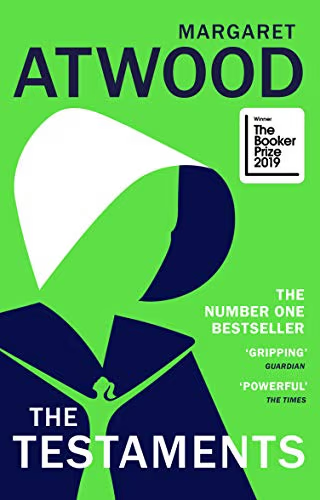
Part of this novel is set about 15 years after the events of The Handmaid’s Tale. There are three voices: Agnes, a young woman living in the fictional Gilead; Daisy, a 16-year-old living in Canada; and Aunt Lydia, the powerful, vicious Gilead functionary who will be familiar to readers from the first book.
The multiplicity of voices is a literary trick that few writers can carry off successfully, and I would have thought Atwood one of those few, but it is not the case. The two younger girls are cliched and predictable. Daisy is a petulant teenager. She argues with her over-protective parents, Neil and Melanie, but also seems unusually perceptive of their differences from other parents — her voice is both dull and erratic.
Neil and Melanie weren’t like the parents of the kids I knew. They were too careful around me, as if I was breakable.
Meanwhile, in Gilead, Agnes is a child going to school, being taught by the ‘Aunts’ — the female Gilead functionaries who manage the women in their various roles and have supreme powers, but only in the women’s sphere. Lessons include modified Biblical stories, learning about subordination to the men, covering up to avoid tempting male sensibilities, how to always be fearful of sex until marriage and then magically dealing with its unpleasantness for the sacred goal of procreation.
Whatever our shapes and features, we were snares and enticements despite ourselves, we were the innocent and blameless causes that through our very nature could make men drunk with lust, so that they’d stagger and lurch and topple over the verge — The verge of what? we wondered. Was it like a cliff? — and go plunging down in flames, like snowballs made of burning sulphur hurled by the angry hand of God.
Powerful, but awfully familiar. We already got all this in The Handmaid’s Tale, through the narrow vision of the Handmaid Offred. The grimly awful Particicutions, where condemned men are literally ripped apart by Handmaids, was first described in The Handmaid’s Tale, and appears over and over again in The Testaments, in almost the same words of description each time, so that they lose their horror from sheer repetition. The few men mentioned are uniformly evil: one Commander has a fetish for teenage brides who then mysteriously die, one dentist sexually abuses his girl patients and his daughter, and Agnes’ father is remote and unattached.
Suddenly it is some years later, and Agnes, terrified by the prospect of marriage to a much older Commander, has been plucked out by Aunt Lydia to be an Aunt-in-training. There are rather dull sections describing her life as a Supplicant, which again add little to the overall impression of Gilead — one expects that the training will be repetitive, tedious, full of dubiously Biblical lists of virtues and sins, with occasional physical punishment, and so it is. Agnes, at this point, seems simply a tool for Aunt Lydia’s machinations, with surprisingly predictable thoughts and actions. Where is the brilliantly perceptive and original view of young girls we saw in Atwood’s Cat’s Eye? This is more like a young-adult novel.
[Daisy] This place is weird as fuck.
[Agnes] I can’t! I just can’t!
Which brings us to Aunt Lydia, the third of the voices, and by far the most interesting. Aunt Lydia was a family judge before the US coup that led to the formation of Gilead. The flashback shows how she was co-opted into the state machinery:
I made choices, and then, having made them, I had fewer choices. Two roads diverged in a yellow wood, and I took the one most travelled by. It was littered with corpses, as such roads are. But as you will have noticed, my own corpse is not among them.
Ah, here is the Atwood-ian restrained elegance and complexity I was hoping for, but alas, Aunt Lydia is just one of the three voices, and the other two are rather one-note.
As for the plot…. there are secrets, which will be easily guessed by the reader. There is Baby Nicole, the child taken to Canada by her Handmaid mother at the end of The Handmaid’s Tale, who has become an emblem of illegal child-snatching in Gilead. Aunt Lydia, the former judge, turns out to be conveniently able to obtain and install secret cameras and microphones with a stone drill and suchlike handy tools. There is a rather unlikely plot point where Aunt Lydia provides a dubious rationale for Nicole, all of 16 years old, to return to Gilead on an elaborate mission to obtain vital documents. Why does it have to be Nicole? Unclear, except for Atwood to bring all the protagonists together, and to create a sort of action thriller.
And towards the end of the book, there is an almost ludicrously metaphorical escape by two girls, one with an infected arm, rowing towards the light of Canada.
I am fucking sorry, but we are in a hot mess emergency here! Now, grab the oar!
Just to check my recollection, I went back and reread The Handmaid’s Tale, which is still intense and brilliant, and makes The Testaments seem very flat. The endings too, are cleverly ambiguous vs blandly pat — I leave it to you to deduce which book has which ending.
This is a novel for those who want every detail of Gilead spelled out, but for most of us, this is a skip-able book.
The Testaments
Margaret Atwood
Nan A Talese, 2019.












Recent Comments