
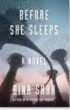
This is maybe a novel for art lovers. The premise is interesting, that our protagonist is Mona, a precocious and charming 10 year old, quietly doing her math homework, suddenly loses her sight entirely.
“She felt a dark shadow fall om both her eyes, as if they were being punished for being so blue, so big, so clear. The darkness didn’t come from the outside, like it usually does, when night falls or the lights in a theatre go down; it snatched her sight from within her own body. An opaque screen had sprung up from inside her, cutting her off from the polygons drawn on her exercise book […] The child, by the casting of some spell, was plunged into darkness” (p15-16).
This blindness lasts 63 minutes, then her sight returns. Her frantic parents rush her to hospital of course, but tests discover no cause for this sudden and temporary blindness. Her paediatrician requires Mona returns for many follow up checks, but only finds her eye sight is in fact exceptionally good. There is however, concern that Mona’s sight may be compromised again in the future, and perhaps even permanently – though why there is this concern is unclear, as there seem no substantiated reason to assume so.
The doctor suggest hypnosis to uncover the cause of the temporary blindness, but Mona’s father and Mona are not convinced. They do agree however that every Wednesday, Mona will see a psychiatrist. Mona’s beloved and adored grandfather, Henry, declares he will take her every Wednesday. But unbeknownst to Mona’s parents, Henry does not take her for psychiatrist sessions; instead, every Wednesday, he takes her to see a work of art. The novel is divided into 3 parts, The Louvre, Orsay (Musée d’Orsay) and Beaubourg, nickname for the Centre Pompidou, which houses the Musée National d’Art Moderne. Each of these 3 parts has chapters named after an artist: Botticelli, Da Vinci, Raphael, Titian, and so on, 52 chapters, 52 artists. Henry is secretly afraid Mona will lose her sight entirely within a year (though again, it is unclear why this time frame), and in case and before that happens, he wants to fill her memory with the sight of beauty, because
“for convenience’s sake, childhood is mainly crammed with frivolous and ugly objects” (p28).
So he wants to train her to see and discuss the works of great masters,
“If one sad day Mona becomes permanently blind, she would at least have the benefit of a kind of reservoir, deep in her brain, from which to draw some visual splendors” (p29).
There is a lot of telling rather than showing, as each chapter contains a long description of the work of art, and then a long lecture by Henry to Mona instructing her about the history, context, techniques, composition, etc. and helping her to appreciate the art. All of this is mildly interesting, and many readers will doubtless have seen a good many of these great works, and appreciate being reminded and being informed further about each. That said, although it is interesting at one level, it is also tedious at another, and I soon learned to skim those long passages of telling. It does not detract from the novel that much, and descriptions of art works can be quite dull to read, even if one knows and likes the work.
There is also Mona’s daily life which makes up the rest of the story. Her parents are in financial trouble, she has friends at school who she is close to and is growing up with, she enjoys developing her mind and understanding with her grandfather’s tutelage. A lot of this detail is enjoyable, even if the language is a little flat, as expected, being in translation from French. There are some odd phrases in translation:
“She clocked the faces with the speed of a cat…” (p226)
– do cats clock faces in France? There sometimes is an odd Americanism, such as ‘doubled down”. Henry’s long lectures to Mona are also highly implausible; even for an art lecturer, to have all this material and references at one’s fingertips, so fluently delivered, is unlikely. The ‘dialogue’ tends towards the monologic, and is just not how real people talk. The language is also well beyond that of a 10 year old, and Mona’s responses, likewise, despite her precociousness.
Mona is also hiding a secret – another short bout of blindness had afflicted her, which she is keeping a secret. The novel tries to build in a little bit of suspense. The novel does depict a rather sweet little girl, eager to please, adoring of her grandfather, kind to her friends, etc, so it does not need passages which tell so heavy-handedly:
“With her adorable pure and humble little heart…” (p258)
I am not clear why authors even write like this, because such sentences turn a reader off the character, rather than convince the reader of the character’s goodness.
Overall, although I am glad to have gleaned a little more about many masterpieces housed in galleries in Paris, I find I skimmed through at least half of this 446 paged novel. The novel seemed a pretext to lecture the reader on art, to give mini, bite-sized briefs on what probably are the author’s favourite pieces and to share his expertise on each. I am not sorry to have read this novel but I much doubt I will be seeking out anymore writing by Schlesser.






Recent Comments